- Home Page /
- Books /
- Computers & Technology /
- Computer Science /
- AI & Machine Learning /
- Intelligence & Semantics /
- Person, Thing, Robot: A Moral and Legal Ontol...

Item #:
83239016
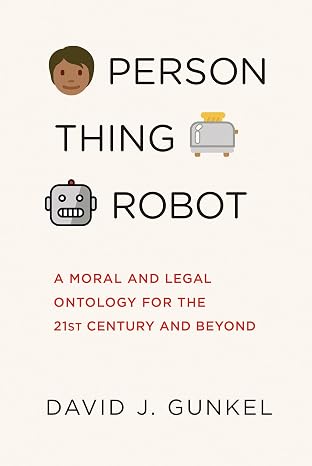
Person, Thing, Robot: A Moral and Legal Ontology for the 21st Century and Beyond
Item #:
83239016
BSD 66
Price Details
Excluding Shipping & Custom charges ( Shipping and custom charges will be calculated on checkout )
*All items will import from US
0 ratings
Write a review
In stock
 Imported from USA store
QTY:
Order now and get it around Thursday, July 16
Secured transaction
Ubuy works hard to protect your security and privacy. Our advanced payment security system ensures confidentiality by encrypting your information during transmission using AES (Advanced Encryption Standards) and SSL (Secure Socket Layer) protocols. Your payment details are 100% secure as we do not share your payment details with third party sellers.
Our Top Logistics Partners


In Person, Thing, Robot, David J. Gunkel sets out to answer the vexing question: What exactly is a robot?

Fast
Shipping

Free
Return*

Secure Packaging

100% Original Products

PCI DSS Compliance

ISO 27001 Certified


What Stands Out
Comprehensive Framework
Provides an extensive moral and legal ontology, addressing modern complexities in understanding the status of persons, things, and robots in society.
Timely Relevance
Tackles urgent ethical and legal challenges posed by AI and robotics, ensuring readers are equipped to navigate contemporary issues across various fields.
Interdisciplinary Approach
Blends philosophy, law, and technology, appealing to interdisciplinary audiences and fostering discussions on the future of personhood and responsibility in a tech-driven world.
Product Details
| Item Weight | 1 lbs (450 grams) |
Who Should Buy?

-
Legal Professionals
Lawyers and judges will gain insights into the evolving legal definitions surrounding AI and robotics in modern law.
-
Ethics Researchers
Researchers studying ethics will find valuable frameworks to analyze moral implications of robotics and AI technology.
-
Technology Developers
Developers of AI and robotics can benefit from understanding legal and ethical standards in their product designs.

-
General Readers
Casual readers may find the academic focus and technical terminology challenging to understand without a significant background.
-
Non-Professionals
Individuals lacking legal or technological experience may struggle to apply the concepts discussed in practical scenarios.
-
Casual Technologists
Those seeking surface-level information on AI and robotics may find this product overly comprehensive and detailed.
Product Description
Person, Thing, Robot: A Moral and Legal Ontology for the 21st Century and Beyond
Have any Query? Chat with us
Customer Questions & Answers
-
Question:
What is 'Person, Thing, Robot: A Moral and Legal Ontology for the 21st Century and Beyond' about?
Answer: This book explores the intricate moral and legal implications surrounding the definitions of personhood, objects, and artificial entities like robots in contemporary society. It delves into how advancements in technology challenge traditional legal frameworks, prompting a reevaluation of rights and responsibilities. This discourse is crucial for understanding how laws may evolve to accommodate sentient and non-sentient beings, impacting areas such as AI regulations and ethical considerations in robotics. -
Question:
Who is the author of 'Person, Thing, Robot'?
Answer: The author of 'Person, Thing, Robot: A Moral and Legal Ontology for the 21st Century and Beyond' is Eric T. Moore. His expertise spans law, ethics, and technology, making him uniquely qualified to address the complexities of moral and legal definitions in an age dominated by artificial intelligence. Readers can expect informed insights based on a blend of philosophical thought and practical legal analysis, enriching their understanding of modern legal challenges. -
Question:
Why should I read this book?
Answer: Reading this book is essential for anyone interested in the intersection of technology, law, and ethics. It provides a thorough analysis of how emerging technologies are reshaping societal norms and legal structures. By understanding these changes, readers can engage in meaningful discussions about the future of morality and legislation in a world increasingly populated by robots and AI. It's particularly relevant for legal professionals, ethicists, and technologists seeking a comprehensive perspective on these issues. -
Question:
What insights about AI ethics does this book provide?
Answer: The book offers critical insights into the ethical considerations surrounding artificial intelligence and its integration into society. It discusses issues like accountability for AI actions, the moral status of robots, and the implications of granting rights to non-human entities. These discussions are vital as society grapples with the potential for AI to make autonomous decisions, thus challenging conventional ethical frameworks. The insights are aimed at fostering understanding among technology developers, policymakers, and ethicists. -
Question:
How does the book approach the concept of personhood?
Answer: The book challenges traditional definitions of personhood by exploring criteria that may apply to both humans and non-human entities such as robots. It investigates philosophical, legal, and ethical dimensions, arguing that as society evolves, our understanding of what constitutes a 'person' should adapt accordingly. This exploration is particularly relevant in discussions about rights, responsibilities, and legal protections for advanced AI systems, marking a significant shift in contemporary legal theories. -
Question:
Is this book suitable for someone without a legal background?
Answer: Yes, the book is accessible to readers without a legal background. It provides clear explanations of complex concepts without delving too deeply into legal jargon, making it suitable for a broad audience. The author presents ideas in a straightforward manner, ensuring that even those unfamiliar with legal intricacies can engage with the material. It's an excellent resource for educators, students, and anyone curious about the future landscape of morality and technology. -
Question:
What are some practical implications discussed in the book?
Answer: The book discusses practical implications such as how laws might need to adapt as AI technology advances. Potential scenarios include setting legal standards for autonomous robots or redefining liability when AI systems contribute to harm. For instance, if a self-driving car is involved in a collision, the question of accountability becomes complex. The discussions in the book are pivotal for policymakers and technologists aiming to navigate these challenges responsibly. -
Question:
How does the book reflect on the future of robot law?
Answer: The book reflects on the fast-evolving field of robot law by presenting future scenarios where legal definitions and frameworks must adapt to incorporate robotic entities. It explores issues like the legal status of sentient machines and the need for regulations to protect society without stifling innovation. For technologists and lawyers, this foresight aids in anticipating and shaping upcoming legislation, ensuring that laws evolve in tandem with technological advancements. -
Question:
Can this book be helpful for policymakers?
Answer: Absolutely. This book serves as a valuable resource for policymakers by laying out the ethical and legal challenges posed by emerging technologies. It offers essential insights that can inform legislation aimed at addressing the intersection of technology and law. Engaging with the content can help policymakers design frameworks that support innovation while safeguarding public interests, making it a crucial read for anyone involved in shaping technological policies. -
Question:
Where can I buy 'Person, Thing, Robot: A Moral and Legal Ontology for the 21st Century and Beyond' in The Bahamas?
Answer: You can purchase 'Person, Thing, Robot: A Moral and Legal Ontology for the 21st Century and Beyond' from Ubuy in The Bahamas. Ubuy offers a user-friendly platform that provides access to a diverse range of products, ensuring a smooth shopping experience tailored to meet your needs. With Ubuy, you can explore this insightful book and many other resources designed to enhance your understanding of contemporary moral and legal issues.
Intelligence & Semantics Editorial Review
No editorial reviews found
Customer Reviews & Ratings
1 customers ratings
-
5 Star
100%
-
4 Star
0%
-
3 Star
0%
-
2 Star
0%
-
1 Star
0%
Review this product
Share your thoughts with other customers
Platform Trust & Buyer Confidence

MT
Mohd
Verified buyer
“The product received very good packaging & safe…Thank You”
16 June 2026 · via Trustpilot
SJ
Shawati
Verified buyer
“Accurate delivery timing given”
16 June 2026 · via Trustpilot
YB
Youcef
Verified buyer
“Not madly expensive like I thought, and much quicker than promised.”
15 June 2026 · via Trustpilot
LM
Leila
Verified buyer
“Never dealt with Ubuy before, but everything worked out great. Seamless cross border purchasing and shipping. Thanks!”
6/7/2026 · via Trustpilot
KA
Kwame
Verified buyer
“The process was smooth, with clear communication and timelines. This was my 1st purchase and I am really impressed. I will definitely be coming back.”
12 June 2026 · via Trustpilot
Secure Checkout
Global Delivery
Easy Returns
Genuine Products
Product Price History
Important information
- Limitations : For products shipped internationally, please note that any manufacturer warranty may not be valid; manufacturer service options may not be available; product manuals, instructions, and safety warnings may not be in destination country languages; the products (and accompanying materials) may not be designed in accordance with destination country standards, specifications, and labeling requirements; and the products may not conform to destination country voltage and other electrical standards (requiring use of an adapter or converter if appropriate). The recipient is responsible for assuring that the product can be lawfully imported to the destination country. When ordering from Ubuy or its affiliates, the recipient is the importer of record and must comply with all laws and regulations of the destination country.
- Not all the products listed on Ubuy are for sale, as Ubuy is a global search engine. Products are subject to export/trade regulations.
BSD 66
Order now and get it around Thursday, July 16
This item is not restrict in my country.(Please click on above link if this item is not restrict in your country, So our team will review and allow.)
QTY:
Secured transaction
PCI DSS compliant and ISO 27001:2022 certified, with encrypted payments and full buyer protection on every order.
Our Top Logistics Partners
Fastest cross-border delivery
Features & Benefits
- Explores the complex nature of robots and their societal roles.
- Challenges existing moral and legal frameworks for classifying robots.
- Proposes a revolutionary new ontology for moral philosophy and law.
- Addresses key issues for academics in moral philosophy, AI, and robotics.
- Provides insights for AI researchers and robotics engineers about social impacts.
- A must-read for anyone involved in technology's intersection with society.
Ubuy Assurance
Experience worry-free shopping with 100% original products, PCI DSS-compliant payment security, ISO 27001-certified data protection, the fastest cross-border delivery, free returns *, and secure packaging on every order.